

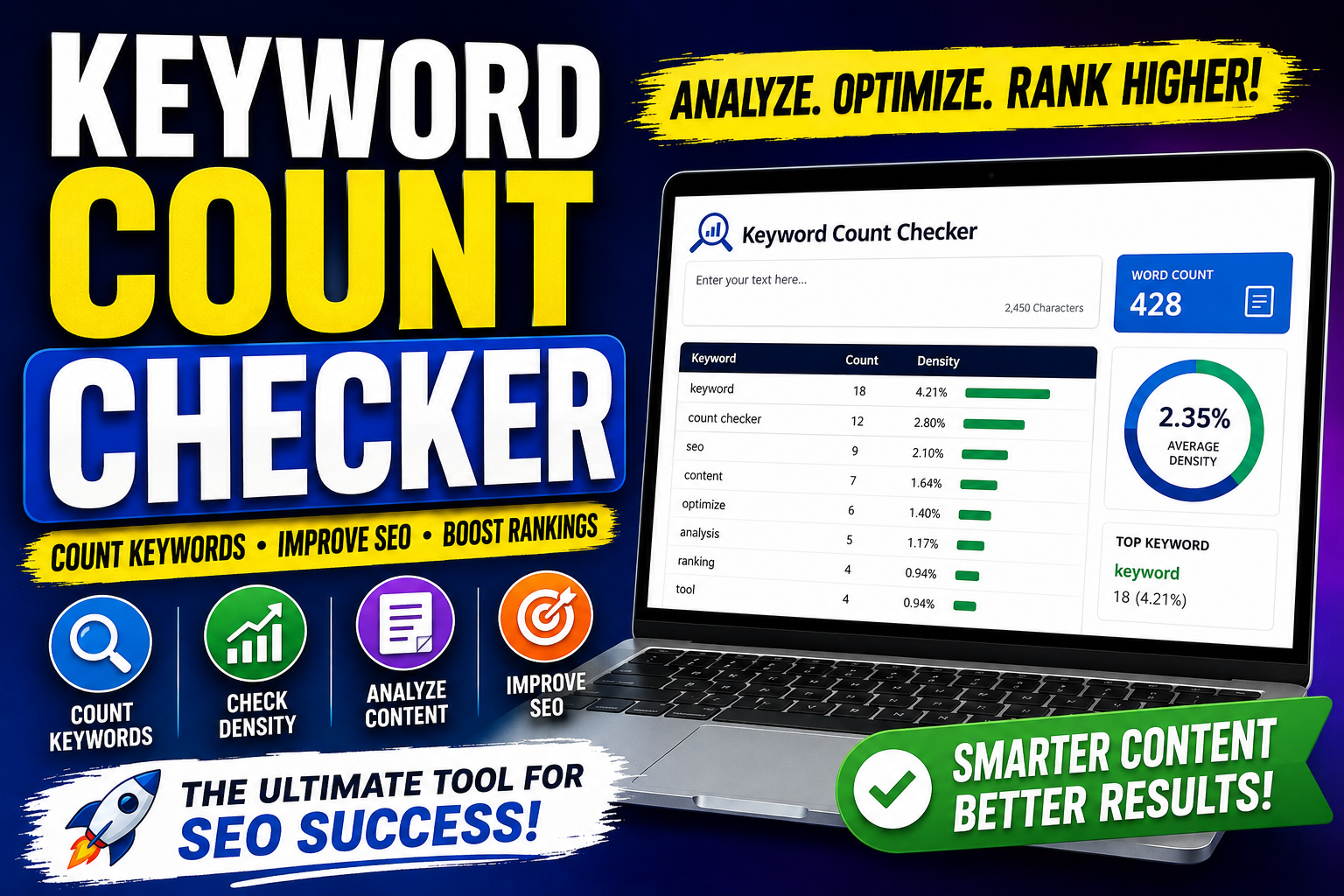
What Is a Keyword Count Checker?
A Keyword Count Checker is an SEO tool that identifies how many times a specific word or phrase appears in a piece of content. It can analyze articles, blog posts, product descriptions, landing pages, and other text to measure keyword frequency and content distribution.
For beginners, keyword counting provides a simple way to understand whether important search terms appear naturally throughout a page. Instead of manually searching a long article, an online keyword density checker can quickly identify primary keywords, secondary phrases, and frequently used terms.
- 🔎 Find keywords quickly
- 📊 Measure keyword frequency
- 🎯 Analyze target phrases
- 📝 Review written content
- 🚀 Support SEO optimization
- 🧠 Understand content relevance
- ⚡ Save valuable time
- 🌐 Check online articles
Why Is Keyword Counting Important for SEO?
Keyword counting helps content creators understand how often important terms appear without relying on guesswork. Search engines use language, context, entities, and relationships between words to understand a page. Therefore, reviewing keyword usage can help writers create content that remains relevant while avoiding unnatural repetition.
Modern SEO is not simply about repeating an exact-match keyword. NLP keywords, LSI keywords, semantic terms, related phrases, and search intent all contribute to topical relevance. A keyword counter can therefore be used alongside content analysis to build comprehensive and useful pages.
- 🎯 Match search intent
- 🔍 Identify important terms
- 📈 Improve topical relevance
- 🧩 Discover related keywords
- ✍️ Strengthen content structure
- 🤖 Support AI search visibility
- 🚫 Reduce keyword stuffing
- 💡 Improve optimization decisions
How Does a Keyword Count Checker Work?
Most keyword counting tools analyze the text you provide and calculate the frequency of individual words or selected phrases. Some tools can distinguish between single words and multi-word keywords, while advanced solutions may also report keyword density, word count, character count, and frequently occurring terms.
The basic process is straightforward: paste or enter your content, select the keyword or review the generated keyword list, and examine the results. A tool such as zuhio can make this process easier for users who want a quick way to inspect keyword frequency before publishing.
- 📋 Paste your content
- 🔢 Count word occurrences
- 🔤 Analyze keyword phrases
- 📐 Calculate keyword density
- 🧾 Review text statistics
- 🧠 Identify repeated terms
- 🔧 Refine weak sections
- ✅ Check the final draft
What Is Keyword Density and Why Does It Matter?
Keyword density describes the percentage of words on a page represented by a particular keyword or phrase. For example, if a 1,000-word article contains a target keyword 10 times, its basic keyword density is approximately 1%. However, there is no universal percentage that guarantees higher rankings.
Rather than targeting an arbitrary density, focus on natural language and useful information. Your primary keyword should appear in important locations when appropriate, while synonyms, related entities, NLP terms, and semantic variations should support the topic. Search engines increasingly evaluate meaning and context rather than simple repetition.
- 📊 Measure keyword density
- 🧮 Compare keyword frequency
- 📝 Use natural language
- 🧠 Include semantic variations
- 🔗 Add relevant phrases
- 🚫 Avoid excessive repetition
- 🎯 Prioritize search intent
- ⭐ Focus on user value
Keyword Count Checker vs. Keyword Density Checker
A keyword count checker primarily tells you how many times a word or phrase occurs. A keyword density checker goes one step further by comparing the number of keyword occurrences with the total number of words. Both measurements can be useful when auditing SEO content, but they answer slightly different questions.
For example, a content writer may first use a keyword counter to determine whether the phrase “keyword count checker” appears throughout an article. A density calculator can then show how frequently that phrase occurs relative to the total content length. Together, these tools provide a clearer optimization picture.
- 🔢 Count exact occurrences
- 📐 Calculate keyword percentage
- 🔍 Compare different phrases
- 📝 Audit blog posts
- 🛍️ Analyze product pages
- 🌐 Review landing pages
- 📊 Examine SEO metrics
- ⚙️ Improve content balance
How to Use a Keyword Count Checker Effectively
Start by identifying your primary keyword and several closely related terms. Enter your completed draft into the tool and review how frequently these phrases occur. Pay particular attention to introductions, headings, body sections, conclusions, image descriptions, and other areas where relevant terminology may naturally appear.
After checking the results, edit only where necessary. If a keyword appears excessively, replace some repetitions with natural synonyms or semantically related expressions. If an important concept is missing, expand the relevant section. This approach produces content that sounds natural while covering the subject comprehensively.
- 🎯 Select a primary keyword
- 🧩 Create semantic variations
- 📋 Analyze the complete article
- 🔎 Check headings
- ✍️ Improve weak passages
- 🔄 Replace unnecessary repetition
- 🧠 Expand topical coverage
- ✅ Perform a final audit
How Keyword Counting Supports NLP, LSI, and Semantic SEO
Search engines increasingly rely on natural language processing to understand what content means. NLP keywords can reveal concepts frequently associated with a subject, while semantic SEO focuses on relationships between topics, entities, questions, and related terminology. Keyword counting helps writers monitor these elements during content optimization.
LSI keywords are often discussed in SEO, although modern search engines do not simply use a fixed “LSI keyword” system for ranking. In practical SEO, the useful idea is to include relevant synonyms, related concepts, entities, and contextual phrases. A keyword counter helps ensure these terms are represented naturally without making the article repetitive.
- 🧠 Use NLP terminology
- 🔗 Add semantic relationships
- 🧩 Include related concepts
- 🔎 Explore contextual phrases
- 📚 Cover subtopics thoroughly
- 🤖 Support AI understanding
- 🎯 Answer related questions
- 🌐 Build topical authority
Best Practices, Common Mistakes, and FAQs
The best keyword-counting strategy combines numerical analysis with human judgment. Never rewrite an article simply to reach a particular keyword percentage. Instead, make sure the content answers the reader’s question, uses clear headings, includes relevant terminology, and provides original value. Keyword analysis should support quality rather than replace it.
Frequently Asked Questions:
Frequently Asked Questions:
Is a Keyword Count Checker useful for beginners? Yes. It provides a simple way to understand keyword frequency and identify unnecessary repetition. How many times should I use a keyword? There is no universal ideal number; use it naturally according to context and search intent. Can keyword counting improve rankings? It can support better optimization, but rankings depend on many factors, including relevance, quality, authority, technical SEO, and user experience. Can I use a Keyword Count Checker for AI SEO? Yes. It can help review terminology and topical coverage, although meaningful content and comprehensive answers remain more important than raw keyword counts. What is keyword stuffing? Keyword stuffing is excessive or unnatural repetition intended to manipulate search visibility. Should synonyms be counted? Yes, reviewing synonyms and related terms can help evaluate broader semantic coverage. Can keyword counting be used for product descriptions? Absolutely. It can help ecommerce writers maintain relevant terminology while keeping descriptions readable. Does keyword density guarantee rankings? No. Keyword density is only one basic content metric and should never be treated as a guaranteed ranking formula.
- ❓ Answer user questions
- 🛡️ Avoid keyword stuffing
- 📖 Prioritize helpful content
- 🔍 Review semantic terms
- 🤖 Optimize for AI search
- 📱 Maintain readability
- ⭐ Provide original value
- 🛠️ Audit before publishing
Final Thoughts
A Keyword Count Checker is a practical tool for writers, bloggers, marketers, students, and SEO professionals who want to understand keyword frequency and improve content organization. It makes keyword analysis faster and can reveal repetitive wording, missing terminology, and opportunities for stronger topical coverage.
However, effective SEO goes beyond counting words. Combine keyword analysis with search intent, NLP, semantic SEO, internal linking, helpful information, strong headings, and excellent user experience. When used correctly, keyword counting becomes a supporting technique for creating content that is useful to readers and understandable to modern search systems.