

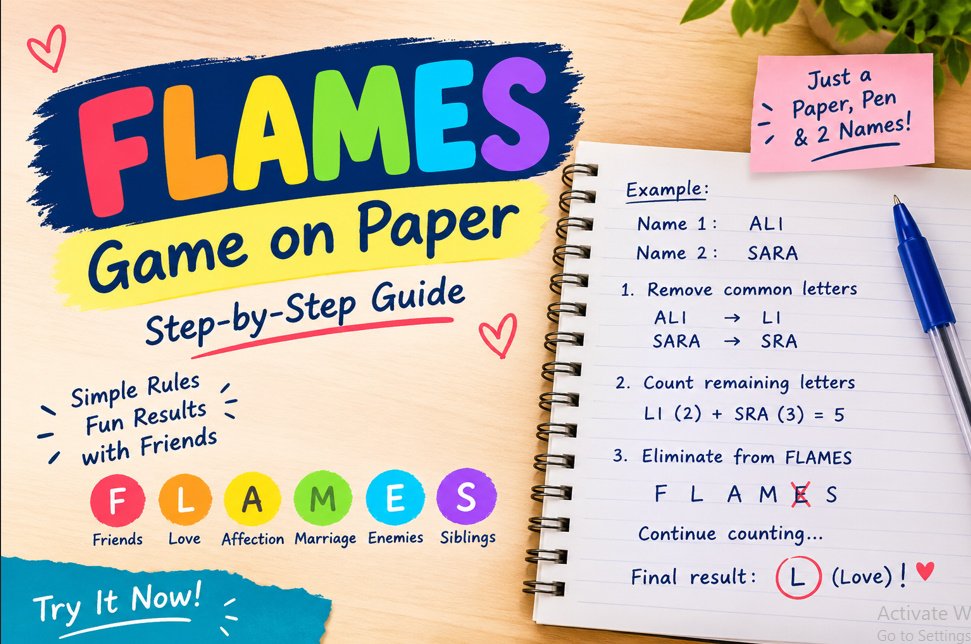
FLAMES is a classic friendship and relationship game that people enjoy playing with friends, classmates, and crushes. You do not need a mobile app, an internet connection, or any special equipment. All you need is a piece of paper, a pen, and two names.
Learning how to play Flames Games on paper is easy because the process follows a few simple steps. You write two names, remove their common letters, count the remaining letters, and use that number to eliminate letters from the word FLAMES. The final letter represents a playful relationship category. Remember that the result is only for entertainment and does not predict real relationships.
1. What Is the FLAMES Game?
The FLAMES game is a popular name-matching activity in which two people’s names are compared to generate a playful relationship result. It is often played at school, during breaks, at parties, or with friends who want to discover a funny compatibility outcome. Its appeal comes from its simple rules and surprising results.
Unlike a formal personality test, this paper-and-pencil game uses letter counting and elimination rather than scientific evidence. You can play it with your best friend, a classmate, a family member, or someone you like. While a flames calculator can automate the counting process, learning the traditional method makes the game more interactive and enjoyable.
- Requires only paper and a pen.
- Uses two people’s names.
- Removes matching letters.
- Counts the remaining letters.
- Follows a letter-elimination rule.
- Produces one final category.
- Works for friends and classmates.
- Is intended for fun and entertainment.
2. What Is the Full Form of FLAMES?
The word FLAMES is commonly used as an abbreviation for six relationship categories: Friends, Love, Affection, Marriage, Enemies, and Siblings. Each letter represents a possible result in the game. Players use the remaining letters from two names to determine which category survives the elimination process.
Different versions may change the order or wording of the categories, but the traditional version uses these six terms. The full form gives the game its name and makes it easy to remember. Understanding each letter is essential before you start playing, because the final surviving letter determines your result.
- F — Friends: A friendship-based connection.
- L — Love: A playful romantic connection.
- A — Affection: Care, fondness, or liking.
- M — Marriage: A pretend marriage prediction.
- E — Enemies: A humorous rivalry category.
- S — Siblings: A brother-or-sister-like connection.
- All six letters are used in the game.
- The result is not a real prediction.
3. What Do You Need to Play FLAMES on Paper?
One of the best things about this game is that you do not need any special materials. A simple notebook page or a loose sheet of paper is enough. You can use a pencil if you want to erase mistakes, or a pen if you prefer to keep a record of each round.
Choose two names and write them clearly on the page. For a consistent result, decide beforehand whether you will use full names or first names only. Most casual players use first names because they make the counting process quicker. The same name format should be used throughout a round to avoid confusion.
- A sheet of paper or notebook.
- A pen or pencil.
- Two names to compare.
- Space to cross out matching letters.
- The word FLAMES written clearly.
- A way to count letters.
- A friend to play with, if desired.
- An eraser for correcting mistakes.
4. Write Both Names and Remove Common Letters
Start by writing the first person’s name on the left and the second person’s name underneath it. Compare the letters in both names, looking for letters that appear in each name. When you find a matching letter, cross out one occurrence from each name. This means every match removes two letters in total.
For example, consider the names ALI and SARA. The letter A appears in both names, so cross out one A from each. The remaining letters are LI and SRA. The first name has two unmatched letters, while the second has three, giving a total of five unmatched letters. This total is the number you will use in the next step.
- Write both names on separate lines.
- Compare the letters carefully.
- Find a letter shared by both names.
- Cross out one matching letter from each.
- Repeat for other common letters.
- Match repeated letters one occurrence at a time.
- Leave unmatched letters untouched.
- Count all remaining letters from both names.
5. Count the Remaining Letters
After removing all common letters, count the letters that have not been crossed out in either name. Add the two remaining counts together to get one final number. This is called the remaining-letter count, and it determines how you eliminate letters from FLAMES.
Using the example of ALI and SARA, the unmatched letters are LI and SRA. There are two letters in LI and three in SRA, so the total is five. Write this number beside the names. Double-check your calculation before continuing, because even a small counting mistake can change the final category in a paper-based FLAMES game.
- Count unmatched letters in the first name.
- Count unmatched letters in the second name.
- Add both counts together.
- Record the total on paper.
- Check that all common letters were removed.
- Do not count crossed-out letters.
- Count repeated unmatched letters separately.
- Use the final total for elimination.
6. Eliminate Letters from the Word FLAMES
Write FLAMES on your paper. Use the remaining-letter count to count through the letters in order. When you reach the number, cross out that letter. For example, if your count is five, count F, L, A, M, E and eliminate E. Continue counting through the remaining letters in a circle, starting again from the beginning whenever necessary.
After eliminating a letter, begin counting again from the next letter that remains, skipping any letters already crossed out. Repeat the process until only one letter survives. This circular counting rule is the most important part of learning how to play FLAMES correctly on paper. Keeping track of the next starting point prevents confusion during the game.
- Write F, L, A, M, E, S in order.
- Count using your remaining-letter total.
- Cross out the letter where the count ends.
- Continue from the next surviving letter.
- Skip previously eliminated letters.
- Restart at F when reaching the end.
- Repeat until one letter remains.
- Record the final surviving letter.
7. Understand the Meaning of Each FLAMES Result
Once only one letter remains, use the traditional FLAMES full form to interpret the result. F stands for Friends, L for Love, A for Affection, M for Marriage, E for Enemies, and S for Siblings. Each category provides a playful answer to the question of what kind of connection two people might have.
For example, a final F means the game labels the pair as friends, while an L gives a love-themed result. These labels are part of a lighthearted guessing game, not evidence of romantic compatibility, future marriage, or actual friendship quality. Enjoy the result without taking it too seriously or using it to judge someone.
- F: Friends.
- L: Love.
- A: Affection.
- M: Marriage.
- E: Enemies.
- S: Siblings.
- Share the result for a laugh.
- Remember that real relationships depend on people, not letters.
8. Play FLAMES Faster with a Flames Calculator
Playing with paper helps you understand the original rules, but manually removing letters and counting around the word can sometimes become confusing. A flames calculator makes the process quicker by comparing names, counting unmatched letters, and performing the elimination steps automatically. It is useful when you want to check your paper result or play several rounds with friends.
If you enjoy the traditional method, use both approaches: first calculate the result on paper, then enter the same names into a flames calculator to compare the answers. This helps you identify counting mistakes and understand the elimination process. Whether you choose a digital tool or classic Flames Games, the main purpose is to have fun with friends rather than discover a guaranteed relationship outcome.
- Enter two names into the calculator.
- Use the same names as your paper round.
- Check how common letters are handled.
- Compare the remaining-letter count.
- Review the final category.
- Correct any mistakes in manual counting.
- Try different names for more rounds.
- Enjoy the game as casual entertainment.
Frequently Asked Questions About FLAMES Games
Can I play FLAMES with full names?
Yes. You can use full names or first names, but use the same approach consistently. Different name formats may produce different results.
What happens if both names have no common letters?
Count all the letters in both names. Their combined total becomes the number used for letter elimination.
Can I play FLAMES alone?
Yes. You can write any two names on paper and follow the same steps to find the result.
Is the FLAMES game accurate?
No scientific evidence supports FLAMES as a way to predict love, marriage, or relationship compatibility. It is a traditional entertainment game.
What is the difference between paper FLAMES and a flames calculator?
The paper version requires manual letter matching and elimination, while a flames calculator automates the steps and displays the result.
Why do two people sometimes get different FLAMES results?
Different name spellings, name formats, or elimination rules can produce different outcomes. Following one consistent method helps avoid confusion.
Can I play FLAMES with my crush’s name?
Yes. Many people play it with a crush’s name for fun, but the outcome does not reveal that person’s feelings.
What is the easiest way to remember the FLAMES full form?
Remember the six words in order: Friends, Love, Affection, Marriage, Enemies, and Siblings.
Final tip: The easiest way to learn how to play Flames Games on paper is to practise with two short names first. Once you understand matching letters, counting the leftovers, and eliminating letters in a circle, you can play without assistance. Use a flames calculator when you want to check your work, and remember that the fun comes from playing together—not from treating the result as a real-life prediction.